
Stevie Wonder
1950 –
Sight Has Nothing to Do with Vision

The harmonica is a toy for most players, a souvenir from a childhood recital. In Stevie Wonder's hands it became a weapon, a conveyor of joy so pure that it seemed to bypass the ears and go straight to the spine. He played it, the piano, the drums, the synthesizer, and every other instrument he could get his hands on, building entire albums from the ground up like a one-man construction crew.

0:30
0:30
0:30
0:30

The fact that he couldn't see the world only made the world he built sound more vivid, more complete, more possible. The limitation became the engine of the invention, and the engine never stalled.

Born in Saginaw, Michigan in 1950, blind from birth, Stevie Wonder signed with Motown's Tamla label at eleven years old as Little Stevie Wonder. The early hits were novelty records -- "Fingertips 0:30" was a live recording that caught him at twelve, a raw blast of energy that went to number one. But the teenage prodigy phase could not contain him. By the time he turned twenty-one he had renegotiated his Motown contract to gain total creative control, a move virtually unheard of for a Black artist in the early 1970s. The cost was legal battles and industry skepticism, but the payout was a string of albums that redefined what pop music could contain and where it could go. He bet everything on his own vision and won every single bet.

Stevie Wonder interview 1990

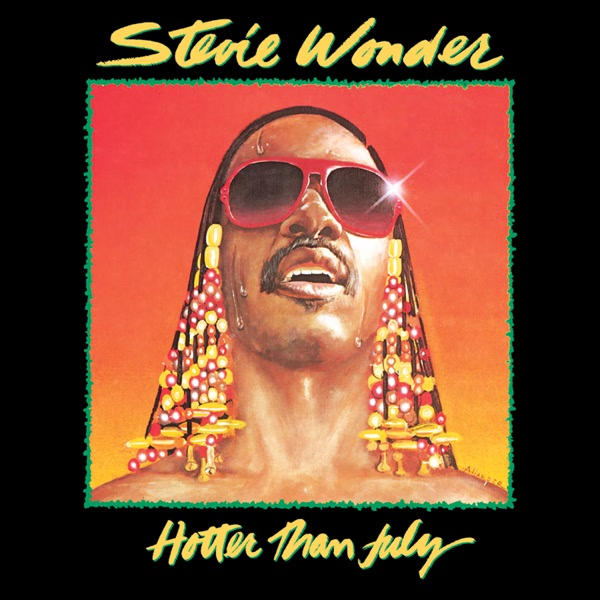
"Superstition 0:30" was the grenade he tossed into the mainstream. Built on a clavinet riff that sounded like a robot with a stutter, a horn section that punched on the one, and a drum part that seemed to be playing in a different and better dimension, the track went to number one and won two Grammys. Wonder played almost every instrument on the record himself, overdubbing voices and parts until the song felt like a parade of one. The album "Talking Book" that contained it was just the start -- "Innervisions," "Fulfillingness' First Finale," and "Songs in the Key of Life" followed, each one a monument to the idea that pop music could be funky, political, spiritual, and romantic in the same four minutes.
The Jazz Soul of Little Stevie (1962)

The run was unprecedented and unrepeated in popular music, a stretch of creativity that still feels impossible.

Still alive and still creating, Stevie Wonder proved that the studio was not a recording facility but a world-building machine. Every artist who plays their own instruments, every producer who hears the whole arrangement in their head before a single fader is moved, every musician who understands that limitation is just another tool -- they're all living in the sonic universe that Stevie Wonder assembled with nothing but talent, a keyboard, and a vision that didn't need eyes to see. The world he built is still standing, and the invitation to visit it never expires.
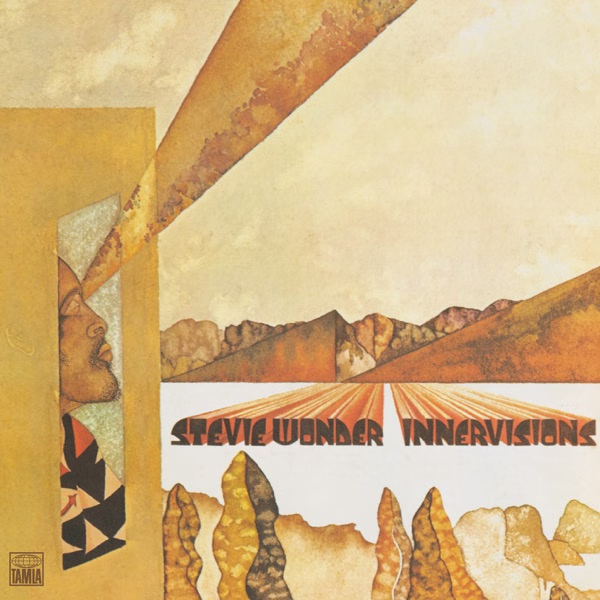
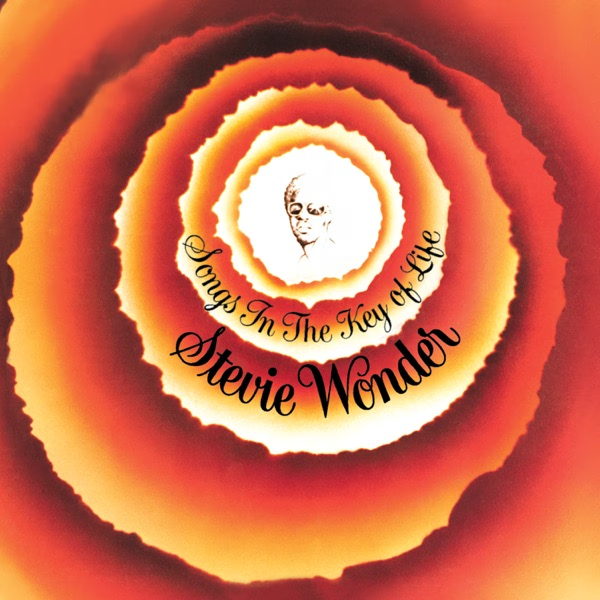
Image Credits

1,414 artist portraits across 5 genres (Rock, Jazz, Soul, Blues, Folk). 1,363 sourced from Wikipedia (Creative Commons / Public Domain), 50 from Deezer (promotional artwork).

Full attribution breakdown →

Stevie Wonder

1950 –
Sight Has Nothing to Do with Vision

The harmonica is a toy for most players, a souvenir from a childhood recital. In Stevie Wonder's hands it became a weapon, a conveyor of joy so pure that it seemed to bypass the ears and go straight to the spine. He played it, the piano, the drums, the synthesizer, and every other instrument he could get his hands on, building entire albums from the ground up like a one-man construction crew.

0:30
0:30
0:30
0:30

The fact that he couldn't see the world only made the world he built sound more vivid, more complete, more possible. The limitation became the engine of the invention, and the engine never stalled.

Born in Saginaw, Michigan in 1950, blind from birth, Stevie Wonder signed with Motown's Tamla label at eleven years old as Little Stevie Wonder. The early hits were novelty records -- "Fingertips 0:30" was a live recording that caught him at twelve, a raw blast of energy that went to number one. But the teenage prodigy phase could not contain him. By the time he turned twenty-one he had renegotiated his Motown contract to gain total creative control, a move virtually unheard of for a Black artist in the early 1970s. The cost was legal battles and industry skepticism, but the payout was a string of albums that redefined what pop music could contain and where it could go. He bet everything on his own vision and won every single bet.

Stevie Wonder interview 1990

"Superstition 0:30" was the grenade he tossed into the mainstream. Built on a clavinet riff that sounded like a robot with a stutter, a horn section that punched on the one, and a drum part that seemed to be playing in a different and better dimension, the track went to number one and won two Grammys. Wonder played almost every instrument on the record himself, overdubbing voices and parts until the song felt like a parade of one. The album "Talking Book" that contained it was just the start -- "Innervisions," "Fulfillingness' First Finale," and "Songs in the Key of Life" followed, each one a monument to the idea that pop music could be funky, political, spiritual, and romantic in the same four minutes.

The Jazz Soul of Little Stevie (1962)

The run was unprecedented and unrepeated in popular music, a stretch of creativity that still feels impossible.

Still alive and still creating, Stevie Wonder proved that the studio was not a recording facility but a world-building machine. Every artist who plays their own instruments, every producer who hears the whole arrangement in their head before a single fader is moved, every musician who understands that limitation is just another tool -- they're all living in the sonic universe that Stevie Wonder assembled with nothing but talent, a keyboard, and a vision that didn't need eyes to see. The world he built is still standing, and the invitation to visit it never expires.

The Jazz Soul of Little Stevie (1962) The Jazz Soul of Little Stevie (1962)
With a Song in My Heart (1963) With a Song in My Heart (1963)
Tribute to Uncle Ray (1963) Tribute to Uncle Ray (1963)
The Jazz Soul of Little Stevie (1962)
With a Song in My Heart (1963)
Tribute to Uncle Ray (1963)
Stevie at the Beach (1964)
Up‐Tight (Everything’s Alright) (1966)
Down to Earth (1966)
I Was Made to Love Her (1967)
Someday at Christmas (1967)
For Once in My Life (1968)
Eivets Rednow (1968)
My Cherie Amour (1969)
Signed
Sealed & Delivered (1970)
Where I’m Coming From (1971)
Talking Book (1972)
Music of My Mind (1972)
soulfunkr&b
The Sunday Drop
One song. One story. Every Sunday.

No algorithms. No trending sections. Just a song someone loved and the story behind it. Delivered Sunday morning.

Free. No spam. Unsubscribe anytime.

Image Credits

1,414 artist portraits across 5 genres (Rock, Jazz, Soul, Blues, Folk). 1,363 sourced from Wikipedia (Creative Commons / Public Domain), 50 from Deezer (promotional artwork).

Full attribution breakdown →

0:00
0:00