
Fred Hammond
1960 –

I need you to understand what it meant when Fred Hammond picked up a bass guitar in the house of the Lord. The church had organs. The church had pianos.

0:30
0:30
0:30
0:30

The church had choirs that could shake the foundation. But Fred Hammond brought the low end, the groove, the pocket that made the praise move from the pew to the aisle. Born December 27, 1960 in Detroit, he grew up in a musical family that understood the difference between singing and testifying. He chose the bass because the bass is what makes the body move, and Hammond wanted the whole body -- not just the soul, not just the spirit, but the feet and the hands and the hips.

He walked into a gospel industry that was still deciding whether urban contemporary gospel was heresy or evolution. He had already paid his dues with the Winans, with the Commissioned group he helped found in the early 80s. Commissioned became the training ground for a generation of gospel stars -- Marvin Sapp came through those ranks. Kirk Franklin emerged from that same current. But Hammond was the one who understood that gospel needed a beat you could drive to, a bass line you could feel in your chest. The cost was steep. The traditionalists called it too worldly. The radio programmers did not know what to do with it. Hammond kept playing. The bass does not argue. The bass just keeps the time.

Fred Hammond interview 1990

"Let the Praise Begin" is not a song you listen to. It is a song you participate in. The call and response, the building energy, the moment when the whole congregation is supposed to be on their feet -- Hammond wrote that into the DNA of urban gospel. "This Is the Day" became a standard that churches across America sing every Sunday morning, often without knowing who wrote it.
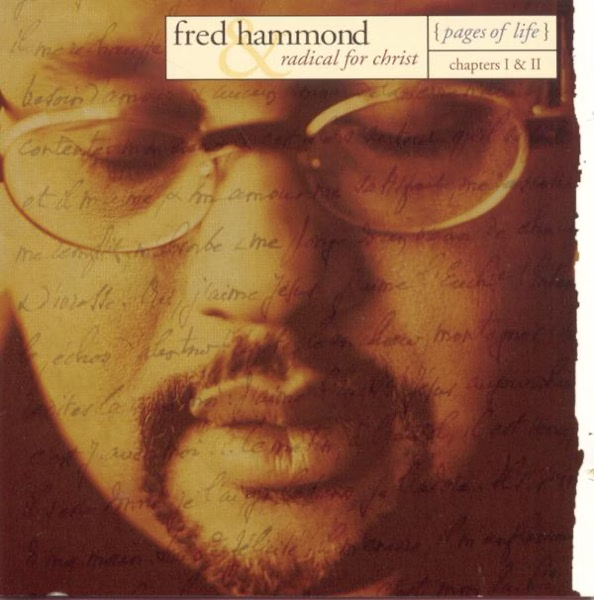
I Am Persuaded (1991)

That is the mark of a writer who has transcended the artist: when your songs become anonymous because they have become essential. Hammond did not just write church music. He wrote the soundtrack for the contemporary black church experience. He took the theology of praise -- not worship, not petition, but outright celebration -- and codified it into songs that worked in the sanctuary and on the radio.

Fred Hammond changed gospel music by trusting the groove. He proved that you could be sanctified and funky at the same time. He opened the door for every urban gospel artist who came after him, every bass player who wanted to serve the church and the pocket simultaneously. The albums he made with Commissioned and as a solo artist are still the standard for what praise music can be. He did not just participate in the gospel tradition. He extended it. The bass line kept playing and the church kept moving, and that is what he gave us -- a faith that could dance.
Image Credits

1,414 artist portraits across 5 genres (Rock, Jazz, Soul, Blues, Folk). 1,363 sourced from Wikipedia (Creative Commons / Public Domain), 50 from Deezer (promotional artwork).

Full attribution breakdown →

Fred Hammond

1960 –

I need you to understand what it meant when Fred Hammond picked up a bass guitar in the house of the Lord. The church had organs. The church had pianos.

0:30
0:30
0:30
0:30

The church had choirs that could shake the foundation. But Fred Hammond brought the low end, the groove, the pocket that made the praise move from the pew to the aisle. Born December 27, 1960 in Detroit, he grew up in a musical family that understood the difference between singing and testifying. He chose the bass because the bass is what makes the body move, and Hammond wanted the whole body -- not just the soul, not just the spirit, but the feet and the hands and the hips.

He walked into a gospel industry that was still deciding whether urban contemporary gospel was heresy or evolution. He had already paid his dues with the Winans, with the Commissioned group he helped found in the early 80s. Commissioned became the training ground for a generation of gospel stars -- Marvin Sapp came through those ranks. Kirk Franklin emerged from that same current. But Hammond was the one who understood that gospel needed a beat you could drive to, a bass line you could feel in your chest. The cost was steep. The traditionalists called it too worldly. The radio programmers did not know what to do with it. Hammond kept playing. The bass does not argue. The bass just keeps the time.

Fred Hammond interview 1990

"Let the Praise Begin" is not a song you listen to. It is a song you participate in. The call and response, the building energy, the moment when the whole congregation is supposed to be on their feet -- Hammond wrote that into the DNA of urban gospel. "This Is the Day" became a standard that churches across America sing every Sunday morning, often without knowing who wrote it.

I Am Persuaded (1991)

That is the mark of a writer who has transcended the artist: when your songs become anonymous because they have become essential. Hammond did not just write church music. He wrote the soundtrack for the contemporary black church experience. He took the theology of praise -- not worship, not petition, but outright celebration -- and codified it into songs that worked in the sanctuary and on the radio.

Fred Hammond changed gospel music by trusting the groove. He proved that you could be sanctified and funky at the same time. He opened the door for every urban gospel artist who came after him, every bass player who wanted to serve the church and the pocket simultaneously. The albums he made with Commissioned and as a solo artist are still the standard for what praise music can be. He did not just participate in the gospel tradition. He extended it. The bass line kept playing and the church kept moving, and that is what he gave us -- a faith that could dance.

I Am Persuaded (1991) I Am Persuaded (1991)
Deliverance (1993) Deliverance (1993)
Revival In the House (1999) Revival In the House (1999)
I Am Persuaded (1991)
Deliverance (1993)
Revival In the House (1999)
Speak Those Things: POL Chapter 3 (2002)
Somethin' 'Bout Love (2004)
Free to Worship (2006)
Love Unstoppable (2009)
Life In The Word (2010)
God
Love & Romance (2012)
United Tenors Hammond Hollister Roberson Wilson (2013)
I Will Trust (2014)
Worship Journal: Live (2016)
Uncle Fred: Texture of a Man (2018)
You Are
gospelurban contemporary gospel
The Sunday Drop
One song. One story. Every Sunday.

No algorithms. No trending sections. Just a song someone loved and the story behind it. Delivered Sunday morning.

Free. No spam. Unsubscribe anytime.

Image Credits

1,414 artist portraits across 5 genres (Rock, Jazz, Soul, Blues, Folk). 1,363 sourced from Wikipedia (Creative Commons / Public Domain), 50 from Deezer (promotional artwork).

Full attribution breakdown →

0:00
0:00