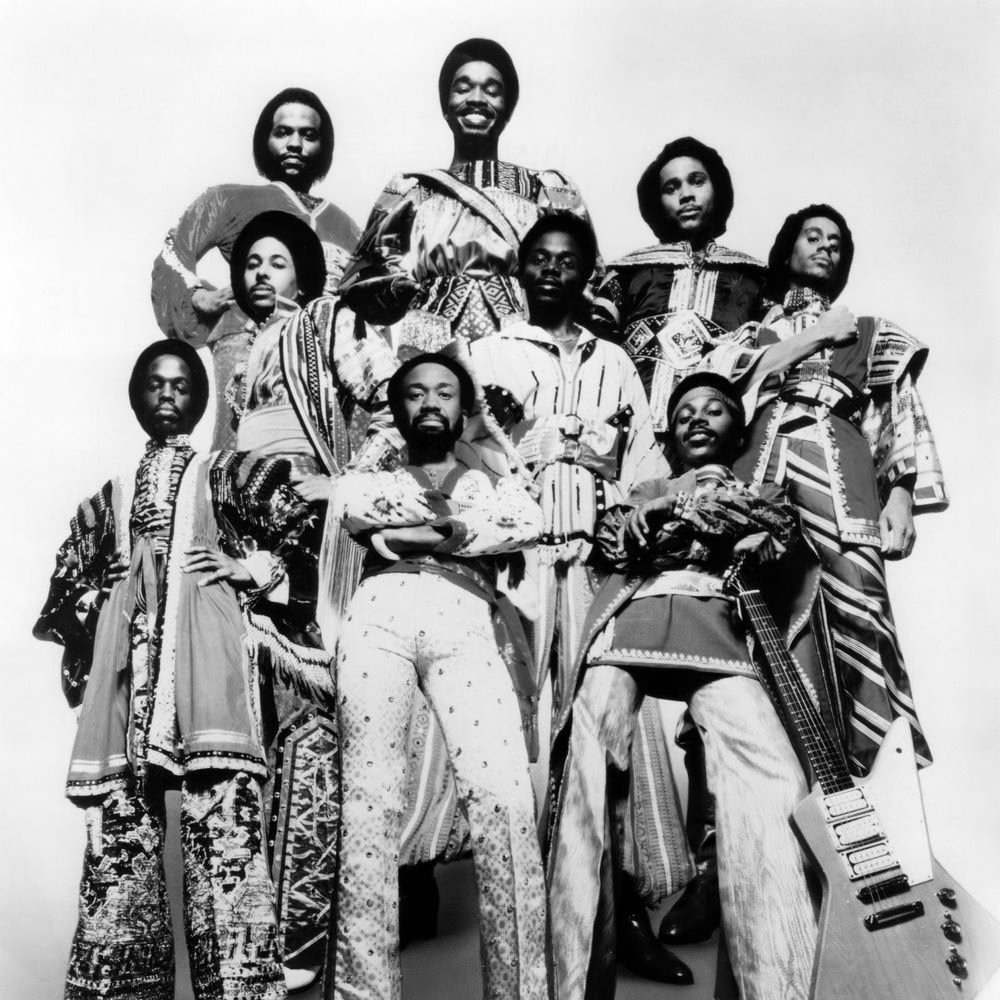
Earth Wind & Fire
1969 –
The Elements Personified

A band that names itself after the elements is either setting itself up for embarrassment or claiming something real. Earth Wind & Fire, formed in Chicago in 1969, claimed it all and backed it up with sound. Maurice White and his brother Verdine White, alongside Philip Bailey and a rotating constellation of musicians, built a group that treated funk as a spiritual practice and pop as a delivery system for something larger.

0:30
0:30
0:30
0:30

They were not a band. They were a congregation with a horn section. From the first note of "September 0:30" you know you are in a different room -- one where the ceiling opens up and the ancestors are invited to dance.

Black popular music in the late 1960s was fragmenting into camps: the political edge of James Brown's funk, the cosmic mysticism of Sun Ra, the polished soul of Motown, the rock crossover that Sly Stone was engineering. Earth Wind & Fire walked into that chaos and refused to choose. Maurice White had been a session drummer for Chess Records and a member of the Ramsey Lewis Trio; he understood the mechanics of both the groove and the studio. The cost of the fusion they attempted was real -- they were too mystical for secular audiences, too funky for jazz crowds, too pop for the underground. They responded by making the biggest, brightest, most audacious sound imaginable. They brought costumes, light shows, choreography, and a message of universal love that somehow never felt corny because the musicianship was airtight.

Earth Wind & Fire interview 1990

"September" is the definitive document, but it is not the whole story. What Earth Wind & Fire did to the listener was architectural. They built songs with multiple key changes, horn stabs that functioned like exclamation points, Bailey's kalimba shimmer, and that rhythm section that locked in so deep you forgot where your body ended and the beat began. "September" hits you with that opening bassline -- ba-dow-ba-dow-ba-dow -- and then the horns enter like a sunrise.

The lyric "ba-dee-ya" means nothing and everything; it is pure phonetic joy, a word that exists only as a carrier wave for feeling. They made funk that could go Top 40 without losing its spine, ballads that did not go limp, and live shows that redefined what a concert could be. They were jazz fusion without the academic chill, pop without the cynicism, soul without the suffering.

The band is still active, which matters less than the fact that their sound is still alive in every sample, every wedding DJ's emergency track, every moment when someone needs a groove that feels like flying. Earth Wind & Fire did not just make songs. They made weather. Fifty years after Chicago, "September" still hits like the first good day of spring. That is not nostalgia. That is the real thing, still turning.

Image Credits

1,414 artist portraits across 5 genres (Rock, Jazz, Soul, Blues, Folk). 1,363 sourced from Wikipedia (Creative Commons / Public Domain), 50 from Deezer (promotional artwork).

Full attribution breakdown →

Earth Wind & Fire

1969 –
The Elements Personified

A band that names itself after the elements is either setting itself up for embarrassment or claiming something real. Earth Wind & Fire, formed in Chicago in 1969, claimed it all and backed it up with sound. Maurice White and his brother Verdine White, alongside Philip Bailey and a rotating constellation of musicians, built a group that treated funk as a spiritual practice and pop as a delivery system for something larger.

0:30
0:30
0:30
0:30

They were not a band. They were a congregation with a horn section. From the first note of "September 0:30" you know you are in a different room -- one where the ceiling opens up and the ancestors are invited to dance.

Black popular music in the late 1960s was fragmenting into camps: the political edge of James Brown's funk, the cosmic mysticism of Sun Ra, the polished soul of Motown, the rock crossover that Sly Stone was engineering. Earth Wind & Fire walked into that chaos and refused to choose. Maurice White had been a session drummer for Chess Records and a member of the Ramsey Lewis Trio; he understood the mechanics of both the groove and the studio. The cost of the fusion they attempted was real -- they were too mystical for secular audiences, too funky for jazz crowds, too pop for the underground. They responded by making the biggest, brightest, most audacious sound imaginable. They brought costumes, light shows, choreography, and a message of universal love that somehow never felt corny because the musicianship was airtight.

Earth Wind & Fire interview 1990

"September" is the definitive document, but it is not the whole story. What Earth Wind & Fire did to the listener was architectural. They built songs with multiple key changes, horn stabs that functioned like exclamation points, Bailey's kalimba shimmer, and that rhythm section that locked in so deep you forgot where your body ended and the beat began. "September" hits you with that opening bassline -- ba-dow-ba-dow-ba-dow -- and then the horns enter like a sunrise.

The lyric "ba-dee-ya" means nothing and everything; it is pure phonetic joy, a word that exists only as a carrier wave for feeling. They made funk that could go Top 40 without losing its spine, ballads that did not go limp, and live shows that redefined what a concert could be. They were jazz fusion without the academic chill, pop without the cynicism, soul without the suffering.

The band is still active, which matters less than the fact that their sound is still alive in every sample, every wedding DJ's emergency track, every moment when someone needs a groove that feels like flying. Earth Wind & Fire did not just make songs. They made weather. Fifty years after Chicago, "September" still hits like the first good day of spring. That is not nostalgia. That is the real thing, still turning.

Earth
Wind & Fire (1971)
The Need of Love (1971)
Last Days and Time (1972)
Head to the Sky (1973)
Open Our Eyes (1974)
Spirit (1976)
All ’n All (1977)
I Am (1979)
Faces (1980)
Raise! (1981)
Electric Universe (1983)
Powerlight (1983)
Touch the World (1987)
Heritage (1990)
Millennium (1993)
funksoulr&bjazz fusion
The Sunday Drop
One song. One story. Every Sunday.

No algorithms. No trending sections. Just a song someone loved and the story behind it. Delivered Sunday morning.

Free. No spam. Unsubscribe anytime.

Image Credits

1,414 artist portraits across 5 genres (Rock, Jazz, Soul, Blues, Folk). 1,363 sourced from Wikipedia (Creative Commons / Public Domain), 50 from Deezer (promotional artwork).

Full attribution breakdown →

0:00
0:00